Hardware Supplies
Buying Hardware Supplies in Kuwait
Hardware is the category every trade needs and almost no one plans a dedicated budget line for — it's the fasteners, anchors, conduit fittings, clips, and small fixings that get bought in the gaps between the bigger material orders, and it's also one of the most common reasons a small task takes an entire extra day. Understanding what actually drives hardware quality and availability in Kuwait makes it far easier to buy it right the first time.
Corrosion resistance is the single biggest differentiator between hardware that lasts and hardware that has to be replaced within a year, and it matters more in Kuwait than it would in a drier, cooler climate. Galvanized finishes — hot-dip rather than a thin electro-plate — hold up against the combination of heat, humidity, and occasional salt air that coastal and near-coastal sites see. Zinc-plated hardware is fine for indoor, dry applications, but specifying it for anything exposed or near a coastal governorate like Fahaheel or Salmiya is a false economy that shows up as rust within a season.
Concrete anchors and drop-in fasteners deserve particular attention because Kuwait's building stock is almost entirely reinforced concrete, which makes a correctly rated anchor the default fixing method for nearly every trade — not a specialty item. The size and embedment depth have to match the load being hung, and this is exactly the detail that gets checked at inspection; an anchor undersized for its load is a defect that's cheap to fix before finishes go on and expensive to fix after.
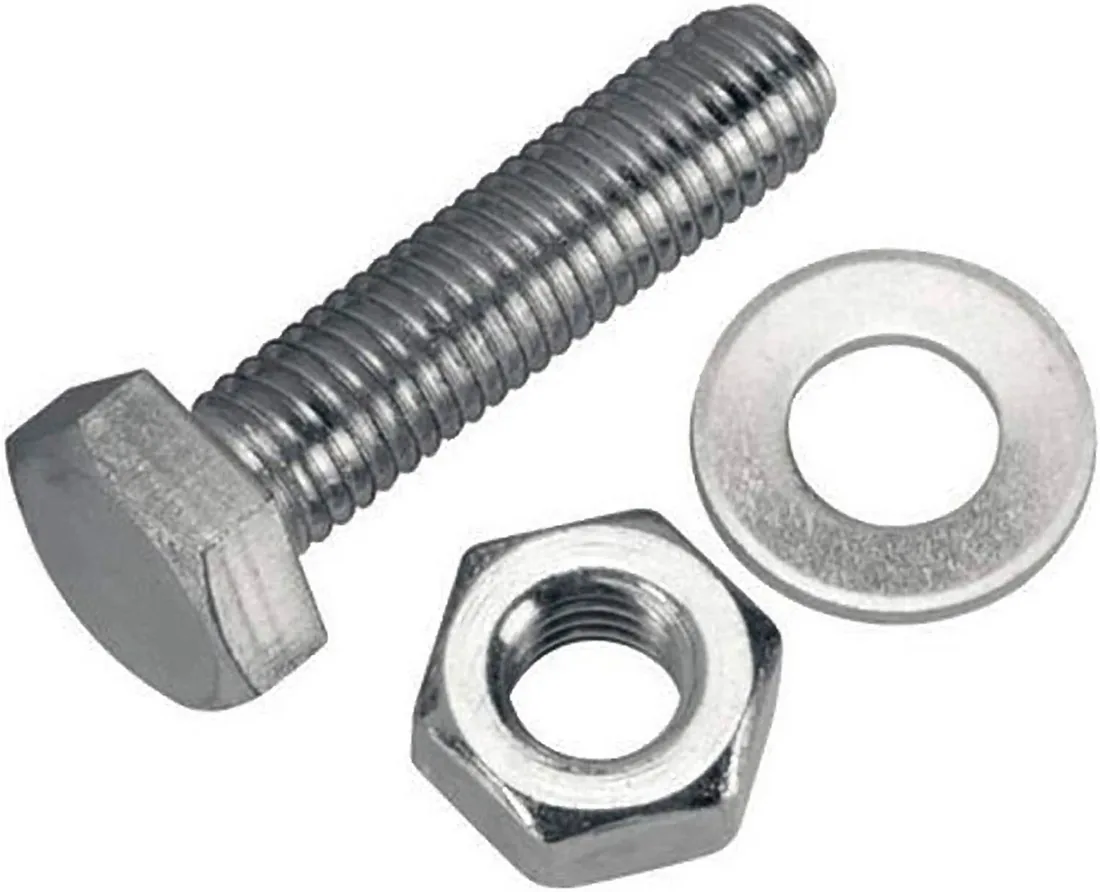
Threaded rods, hex bolts, nuts, and washers move in higher volume than almost anything else in a hardware order, because nearly every trade — structural, MEP, and fit-out — uses them continuously rather than occasionally. Buying these by the box rather than piece by piece isn't just about unit pricing; it's about not stalling a whole crew because one small item ran out mid-installation and nobody has time for a supply run in the middle of a shift.
Electrical and conduit hardware — saddles, clips, adaptors, bushes — needs to match thread standard and size to the rest of a conduit run exactly, not approximately. A mismatched fitting either doesn't seat properly or leaves a wiring installation exposed to moisture ingress, which is one of the first things an electrical inspector checks before signing off a job. Keeping a small stock of the common sizes used across a project avoids discovering a mismatch at the worst possible moment — during final connection.
Rivets, pop fasteners, and duct-specific hardware are worth sourcing from a supplier who understands sheet-metal and HVAC applications specifically, because the mandrel material, body alloy, and size range that work for general sheet metal aren't always the same as what a duct fabricator needs for flange and connector work. Buying from a generalist hardware source sometimes means the range simply doesn't go deep enough into the specific sizes a duct crew actually uses.
For bulk hardware buying, the practical approach is the same one that works for any construction material: consolidate the full list — every fastener type, size, and finish — before requesting pricing, rather than ordering piecemeal as each need surfaces. A single detailed list lets a supplier confirm stock across everything at once and usually unlocks better bulk pricing than five smaller orders placed over a month.
Super Tech stocks a wide hardware range — galvanized fasteners, concrete anchors, threaded rod, conduit fittings, rivets, and duct hardware — from Shuwaikh Industrial Area, with trade quantities and delivery available across Kuwait. If you're not sure which finish or grade fits your application, send us the details through the contact page or WhatsApp and we'll confirm the right spec before you order.